Thursday, 3 April 2014

Volunteering at NWC

Some do it to gain experience, some do it to meet new people, some do it because they simply want to help…in the end it does not really matter why people volunteer, but the impact that they make.

Even though NWC is providing a fair payment for all the locals working in NWC, the work of volunteers is nevertheless an essential component of their work and especially development.

I came to NWC in February, because I wanted to put my time to good use. Volunteering abroad while struggling to find a job at home seemed like a good opportunity for my professional and personal development. And I sure was right!

Having spent two months in Kigali, I believe that this was one of the best decisions I have ever made. I was responsible for the planning and supervision of the work in the library, but as is the case in all small projects, I ended up helping with all the activities, where they needed my help. And despite the fact that I was here to help the Center, I at the same time learned so much about the people, their everyday life and also the work of a community based project. Even though I had worked in multicultural environments before, my experience in NWC really gave me a chance to see the cultural differences first hand. I learned to admire the African ease at work, not stressing about the pressing deadlines, and just smile while they go on with their everyday activities. On the other hand I sometimes felt like a cranky European pushing them around, despite my nervousness would not speed up their process at all. But by now I just smile and relax as well …and you know what? In the end everything really works out just fineJ.

My time in Kigali is now coming to an end, but NWC is always happy to welcome new volunteers, locals and expats, living in Kigali, who are willing to dedicate some of their time to the successful work and development of Nyamirambo Women’s Center. 

 Monica, Eva and Drew planning the tour guide training (Gertrude is missing in the picture)

 Monica is the leader of Umutima project

I was responsible for the planning and supervision of the work in the library

Tuesday, 25 March 2014

Ladies behind the name “Umutima” - Part II

Two weeks ago we started with presenting the ladies who are making the beautiful Umutima products and today we continue with the next two stories. 


BYUKUSENGE FRANCINE

Francine’s delicate features and strong cheekbones frame her confident voice as she proudly states that each of her eight children attend school regularly. Although she never finished public school she did receive technical training: learning to cook, sew and care for children.

Francine came to the Nyamirambo Women’s Center to teach sewing. But it wasn’t long before she discovered that she too had many things to learn. The Women’s Center has changed her life forever. The money she earns in combination with her husband’s income allows her family to make ends meet.

She loves the exposure to the European style of clothing she is learning to sew, especially the children’s skirts and pants. She believes that the high quality of products the Women’s Center produce will allow them to be a success in the marketplace. 


UMUTESI MIRIAM


Walking along the road six years ago, Miriam now 28 years old, was struck by a moto. She was left with a broken leg and a traumatic head injury. Three months in the hospital and another three months healing at home used all the money Miriam had managed to save. The accident has left Miriam with a permanent damage to her left eye. 

Miriam lost her parents to the Genocide. But during the difficult times, her older sister provided limited assistance. Her community recommended that she search a way to care for herself and her four year old daughter.

Miriam has been with the NWC for five months now. She has learned to sew and is committed to continuing to learn and develop her skills. Miriam speaks confidently and states: “My story was bad but I have found a new family here at Nyamirambo Women’s Center. I can come here and be happy and strong.”


Tuesday, 18 March 2014

Nyamirambo is the place to be!

One of the core activities in NWC is community based tourism. Having in mind that Nyamirambo is known as the most vibrant and authentic part of Kigali, it seems like a perfect fit. The ladies from the Center have been doing the tour in English and French since 2009 and so far more than 280 people have visited Nyamirambo under their guidance.


The tour starts in Nyamirambo Women’s center, where the guide presents the work of the Center and teaches you some basic Kinyarwanda to help you interact with the locals that you will meet along the tour. Remembering Muraho, Murakoze and Muzungu is a must! J

Then you walk to the Biryogo market, which is just across the street of the Center. There you can see the local vegetables and fruit stands, you can learn the process of drying cassava and participate with the ladies making isombe (cassava leaves mixed with onions, green pepper, garlic and sometimes spinach). In addition you can see local Muslim embroidery or carpet weaving as well as the local cooking stoves and some fabulous African fabrics.


After the market you walk on, passing the mosque (yes, Nyamirambo is a Muslim area of Kigali) and visiting a hairdresser salon and a tailor store. The walk is not long, but filled with interesting stories of people who live here, which gives you a good impression of how everyday life of local people looks like.


To put the cherry on the top, you can end your visit with a lunch at one of the ladies from the Center. Let’s just say that no one has ever left Aminatha’s place hungry. Moreover, it’s also a good way to try local food such as bananas, sweet potatoes, cassava, posho and beans.


In 2014 Eva joined the team to compliment the local experience with professional knowledge. In the near future the Center will therefore start with official trainings for the guides, which will make their performance even better. Also the Center is planning to incorporate further community walking tours into their portfolio, such as a handicraft tour or a culinary tour; so stay tuned!

And if we return to community based tourism that we mentioned at the beginning – all the locals that we visit along our tour get some compensation, so with your visit you will not be supporting just NWC but a wider community.

You can always arrange your visit per telephone (+250 782 111 860 and +250 785 002 302) or email (nwcoffice.kigali@gmail.com).  

We are looking forward to meet you!

Monday, 10 March 2014

Ladies behind the name “Umutima”

After our last blog, you might be wondering who are these ladies whose products you want to have. We thought you would! J

That is why we decided to present them to you with short stories of their lives and their view of NWC.
The stories are the result of interviews that were conducted by Jody Nathan with the help of her translator Henry Bizabityo.


MUKAMUGUNGA EUGENIE

During our interview Eugenie’s young son stops on his way home from school to visit. His book bag is bulging, heavy with books. Eugenie first came to the Women’s Center to learn English.


After the Genocide in 1994 she and her sister were living in an orphanage. Some European workers wanted to offer her a job, but because she did not speak English they were unable to hire her. It crushed her heart. She vowed to never miss another chance.

Eugenie, now 44 years old, is the sole provider for her family. Her husband is permanently traumatized from the events of the Genocide and is unable to work. The money she earns at the Women’s Center provides enough for her family’s needs. They have no housing expenses because they live in a family member’s home. Eugenie dreams of one day living in their own home. 

She hopes to continue working with the Center and one day teach others to read and write. She wants to pass along the knowledge so other women can help themselves. She believes this can be accomplished by “working hard and working together.”


MUSABYINGABIRE EPIPHANIE


Epiphanie found the Women’s Center through a friend. She was excited to hear about the literacy, sewing and computer classes that the Center was offering. Epiphanie worked at home. Her husband is a businessman and their four children attend school. Epiphanie approached the possibility of becoming involved in the Women’s Center with her husband and in 2011, she did just that!

Now in 2014 she teaches the Kinyarwanda Literacy classes for the Center. Illiteracy in the native Kinyarwanda language is just one of the many challenges here in Rwanda. Epiphanie knows all too well the isolation that Rwandese women can feel and hopes to one day develop and participate in a community outreach program that could lead more women and even men to develop skills that could help improve their lives.

Tuesday, 25 February 2014

UMUTIMA – the brand that you should remember

It is amazing how much can be made in a short period of time. I am talking about the sewing project in NWC, which only started in October, but it now feels that it has been here forever.

The master chef behind the project is Monica, who has a vision of creating unique and quality products, which set them apart from the rest.

They started off with producing simple things, for example blankets, table runners, napkins and pillow cases, but with time the ladies working here became better and better, so the production expanded quickly to producing bags and even clothes for children. In the future they would also like to start making clothes for adults. The ideas for the products are the work of San, who helps Monica to run the whole project.

It is important to emphasize that even the so called simple products have a special touch, because the fabric is always precisely chosen and also hand stitched. Knowing how much effort is put in the work, the brand name is actually no surprise – umutima means heart in Kinyarwanda.

Here I would also like to highlight that all the ladies working in the center are paid fairly for their work right after the product is finished (and not when it is sold), which results in their happiness when coming to work.

Lastly, you are always welcome to come to the center and check out our latest products. And for those far away we are posting some pictures, which will convince you that Rwanda should be your next travel destination! J


Monica is the leader of the project “Umutima”


Monday, 17 February 2014

NWC Library is officially open!

Claire finished her last post with the quote from Albert Einstein: “The only thing you absolutely have to know, is the location of the library.” and we are proud to say that from this week on, you can find a library also in our centre.

For now we offer more than 500 books in Kinyarwanda, English and French, but we hope to have even more in the near future. We divided them in four categories – adults, teenagers, children and young children. The membership in the library is free, but we do charge a deposit if you want to borrow a book (which of course you get back, once you return the book).

Moreover, during our working hours (Monday, Wednesday, Friday: 13.00-17.00; Saturday: 9.00-12.00; Umuganda: 14.00-17.00) we will also read stories for the children and do crafts with them in order for the stories to become alive.

We hope to see you soon in our library!


Thursday, 17 October 2013

Preparing the Library

One of my main jobs while I've been at NWC has been to buy books for the community library that will open in January.

I love buying books, so this was hardly work for me. But it was a surprisingly difficult task. Me and Marie Aimee went to different publishers, often multiple times, and found new book shops, trying to track down the best range of fiction we could find in Kinyarwanda, English and French, for those with low levels of literacy, to more advanced readers.

As the library grows the center will be able to adapt the selection of books to what people like to read. But for now, I enjoyed carrying boxes of new shiny books, staking up piles as I walked around the store and seeing some of the books I read as a child with new covers and pictures ready to enthrall another generation.

“The only thing that you absolutely have to know, is the location of the library.” 
― Albert Einstein

Monday, 14 October 2013

Getting on

My posts on the blog are going to be a little backwards and a little different.

My name is Claire and I’m actually just about to finish working at Nyamirambo Women’s Centre. For various reasons I’ve only just got access to this blog, and I leave in 6 days. But I’ve been here for 5 weeks, so I’m sure I can find a few stories to tell you, just forgive me for doing them in a funny order.

This week, my last week, things are quite quiet at NWC. It’s weeks like this that you see how an organisation slowly ticks by, doing the tasks it needs to, without much show or any real attention.  We like to hear the stories of great battles, big events, angry words or ugly accusations, but the real story of any organisation, any movement, is to be heard when everything is quite, the truth whispering on the breeze.

In the office Marie Aimee, the President works away, popping out to meet people when she needs to, and trading the internet stick with me when one of us needs to get online. The computer class sat around the tables in the office this morning, new pine tables ready to go into the library when it opens in January. Marie Aimee and I kept working as the gentle noises of the lesson drifted past. Next door in the class room the ladies are working away at the newest sewing project that I’ll tell you about some other day. Their hands stitch feverishly and they chatter between themselves as they work.  At the back are two of our volunteers, cutting fabric and hatching plans for the next big sewing invention to sweep through NWC.


Getting on is what we’re doing. And in some ways that’s just what the people of Rwanda have been doing these past fifteen or so years. Getting on after your world is turned upside down. Even though we like the stories of big events and angry words, the real change happens when everything is quiet and the people get back to the business of getting on.

Monday, 10 September 2012

Keep your fingers crossed!

A current project “Nyamirambo Women’s Center - Women for Women” funded by Ministry of Foreign Affairs of the Republic of Slovenia and the Peace Institute is coming to the end. From September onwards NWC doesn't have any sources of funding, not even to cover the basic costs such as NWC office rent. 

Last couple of weeks we were busy writing a project proposals. We were actively fundraising to ensure an uninterrupted work of the Center after the termination of the current project. We have applied to several potential donors - The Global Fund for Women, The African Women's Development Fund, ASA Program, and sent a letter of intent to Norwegian People's Aid. We have also started to work on a proposal to Open Society Institute - East Africa.
Grants would be used for an uninterrupted continuance of our activities, including administrative expenses necessary to keep the program running. The activities funded by these grants would contribute to socio-economic empowerment of women and poverty reduction, through trainings for income-generating activities, providing women with knowledge, skills and capacities, and achieving even greater impact of Nyamirambo Women’s Center in the local community.

So, keep your fingers crossed! 


Thursday, 6 September 2012

How to write a good and successful project proposal

A project proposal is a detailed description of a series of activities aimed at solving a certain problem. Without direct project funding it would not be possible for NGOs to accomplish goals. Writing clear, thorough and targeted project proposals is therefore an essential to NGOs success. Mastering the art of writing a project proposal required unified approach to project management. The project proposal should be a detailed and directed manifestation of the project design. It is a means of presenting the project to the Funder in a format that is immediately recognised and accepted.

The art of writing successful project applications and raise funds for projects is not impossible for anyone. It is all about using the right tools, doing the right things and work structured

Since I've noticed lack of this skills among NWC members I decided to organize and carry out the workshop on writing a successful project proposal The aim was to enable participants understand the tools and techniques of effective project proposal writing that would facilitate funds flowing in the organisation.

Muzungu talks about some strange things

The training workshop was designed for middle and senior level project managers, team leaders and volunteers, who are directly or indirectly involved in writing the project proposal or concept notes, or are expected to be engaged in such activities in future.

Some NWC members participated, together with members of our partner organizations and few students and teaching assistants from KIST. Some of the topics covered - How to find funding; How to write a successful application; How to define goals, activities and outputs; How to describe methodology and timetable; How to foreseen potential risk, mitigation measures, evaluation and criteria for success; How to create a reasonable budget... 

Let's hope they learned something out of it. :) Knowledge gained through this kind of workshops is of no use unless and until we implement it in our practical life (or in our organization's life). Implementing the knowledge is nothing but the experience gained through it.

Wednesday, 5 September 2012

Going phoneless

Another phone has gone. This time mine. :) A young guy drop by at the office this morning, asking for Vestine. He said he has some papers for here. I answered that she'll probably come in half an hour or so. But he said it's urgent and asked if I have her phone number. I gave him my cellphone to call her. He started to talk to her, asking when she'll be in the office, and suddenly started to run away...

I'm too naive sometimes.. :) OK, it was old and crappy phone, but still..

Although, maybe this incident is not that bad at the end. I made a list of several benefits of having no phone. Here’s what I came up with:
  • No more phone bill
  • No roaming fees
  • No more international billing tricks
  • No more phone calls during dinner
  • No more being woken up in the middle of the night
  • No more being distracted by Facebook or Twitter or Foursquare every free moment
  • No more arguments about whether your iPhone is better than my Android or Blackberry
  • No more checking my phone to see if I missed a text message
  • No more worry about brain cancer
  • Smaller carbon footprint
  • More freedom
  • More presence in the moment
  • More money left at the end of the month
Sounds good, doesn't it? Seems like I have a solid case on this one. But it's more likely I'll go and buy another one this afternoon... :)

Tuesday, 4 September 2012

Combating Gender Based Violence

Violence against women has profound implications for health but is often ignored. It's one of the most common forms of violence against women is that performed by a husband or male partner. This type of violence is frequently invisible since it happens behind closed doors, and effectively, when legal systems and cultural norms do not treat as a crime, but rather as a "private" family matter, or a normal part of life.

A WHO multi-country study found that between 15–71% of women reported experiencing physical and/or sexual violence by an intimate partner at some point in their lives. These forms of violence result in physical, mental, sexual, and reproductive health and other health problems, and may increase vulnerability to HIV.

Risk factors for being a perpetrator include low education, past exposure to child maltreatment or witnessing violence between parents, harmful use of alcohol, attitudes accepting of violence and gender inequality. Most of these are also risk factors for being a victim of intimate partner and sexual violence. Situations of conflict, post conflict and displacement may exacerbate existing violence and present new forms of violence against women.

School-based programmes to prevent relationship violence among young people (or dating violence) are supported by the best evidence of effectiveness. Other primary prevention strategies, such as microfinance combined with gender equality training and community-based initiatives that address gender inequality and communication and relationship skills, hold promise.

In accordance to those facts, Nyamirambo Women's Centre actively take steps to organize and run educational programs for the local women on issues like gender-based violence, sexual and reproductive health, birth control, women empowerment... NWC strives to influence the local community through formal and informal education, encouraging the role of women in local authorities and economic activities, awareness-rising about sexual and reproductive health and in the fields of human rights and women’ rights, generally.

The workshop on Gender Based Violence was held on Sunday. The interest was enormous - more then 35 women and girls participated, we had to bring more chairs from my room, and still some of the participants had to stand...

 
Vestine and Esperance spent over three hours lecturing and answering to dozens of questions. It is aimed at providing participants with a good understanding of the dynamics of abuse and foundation counselling skills for domestic violence and rape. This enables participants to provide basic support to victims of gender based violence. Some of the topics covered in the course include the following: domestic violence, intimate partner violence, mental & physical health, prostitution, risk factors and prevention, sexual assault...


Saturday, 1 September 2012

Eat to live, don't live to eat

The food here is delicious and locally grown, with few artificial ingredients, but people here seem to like fried food, mayonnaise and a lot of sugar and salt, as Nina wrote a month ago. So, the second workshop on healthy nutrition was held today at NWC

Workshop started with a brief presentation of basic rules and recommendations when it comes to food and health. A healthy diet involves consuming appropriate amounts of all essential nutrients and an adequate amount of water.

Aminatta and me by the charcoal stove
Nutrients can be obtained from many different foods, so healthy diet needs to have a balance of fats, proteins, and carbohydrates, calories to support energy need and micro nutrients to meet the needs for human nutrition without inducing toxicity or excessive weight gain from consuming excessive amounts.

But, the real fun started with actual cooking session!
All members were present and responsible for some work (pealing potatoes, cleaning spinach, slicing carrots, onions, tomatoes, eggplants, preparing the meat...), under the supervision and guidance from our great cook Aminatta.

After few hours of cooking delicious and healthy meals were ready.

Ready-to-serve food

So, we could finally invite local kids for a lunch. More then 60 children, ages 2 to 12, ran to our backyard, sat on the floor and quietly waited for their free meal. We served rice, boiled potatoes, spinach with eggplants, and some nice looking beef stew (I can't judge on the taste, though).

At the end, all kids got a glass of milk and some fresh bananas. 

Esther serving milk
More photos can be found on our Facebook page. Check it out, and like it! :)


Friday, 31 August 2012

Exam Week

This week was all about tests. Final exams were given to students of English, literacy and computer courses. The purpose of these tests is to make a final review of the topics covered and assessment of each student's knowledge of the subject.


English course Final Exam
English class was really good - 17 students took an exam, and their score was 43 points (of 62) in average, which makes 70% of correct answers! Well done, girls!


Tuesday, 28 August 2012

More tourists coming?

Responsible Community-Based Tourism is a core activity of the economic empowerment of the NWC and is implemented in accordance with the principles of responsible tourism. In Rwanda, there is a variety of community-based tourism initiatives developed around the Millennium Village Project, however, there are no similar tourist initiatives in an urban environment in Rwanda yet.

The community-based tourism run by the NWC aims to carry out income-generating tourist activities in an urban environment in Kigali, in particularly in Nyamirambo district – a merchant quarter with a majority Muslim population and with numerous religious, cultural and historical sites.

James Scipioni from community-based tourism and eco-tourism agency Go Barefoot (London, UK) paid a visit to NWC on last Friday. He wanted to see the possibilities of including our tours in some of their Rwanda packages. We presented our work and took him for a walk around Nyamirambo.

The tours would give an insight to the visitors and tourists on the every-day life, social events, business etc. in Kigali. Visitors can obtain genuine information and knowledge on Rwandan people and culture, and at the same time they can get an opportunity to become actively involved in the NWC activities through voluntary work or to take part in NWC’s events, workshops and courses such as drumming course, traditional Rwandan dance course, and traditional Rwandan cuisine cooking course etc.).

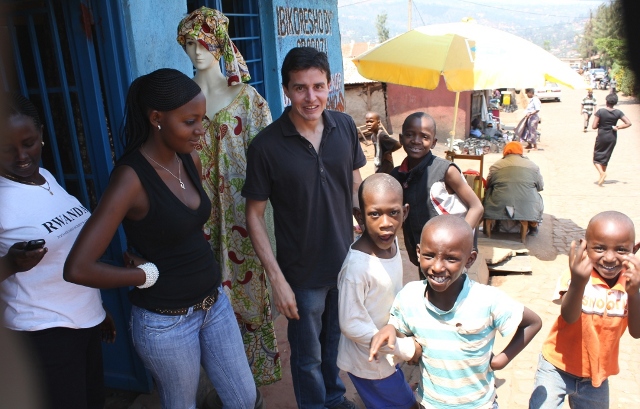
James Scipioni with local kids in front of tailor's shop at Biryogo

Thursday, 16 August 2012

What's new in Nyamirambo?

What's new in Nyamirambo? New Muzungu is in the neighborhood! I came on last Wednesday, we landed in the mid of the night. It was cold, wet, windy, misty... Muzungu in the mist.

So, the first week is behind me. And what a week! First impressions - it's great! There are no mist, rain, wind or mud anymore, people are nice and friendly, children are so cute, basic words in Kinyarwanda are not that much difficult to learn, NWC is doing a remarkable job for the community. Biryogo rules!

I've started giving English and computer classes. There are 5-8 women in the group, sometimes more. Everyday, Facebook is the lesson number one (when our Internet provider let us)! We can't start a class without checking our profiles first, laughing at the pictures, sharing and posting things at the walls, sending "we miss you" messages to Marko (previous volunteer from Croatia)...

Then more serious things are coming; we started with basic Excel features and formulas, so girls are now capable to create simple tables and charts, calculate their incomes, track the number of handicraft produced, their share in percentage, and things like this. They've learned how to import those spreadsheets and charts in the Power Point presentation as well. We are going to take s small exam next week to check what they have remembered. :)

IT course

The problem with computer classes (besides very lousy Internet connection) is that we have only one laptop that we can use. It is hard to explain things when everyone can't see the screen and follow you. We could use my laptop too, but it's run on Linux and I'm sure that Ubuntu and OpenOffice would cause more problems and confusions in the group. So, we stick to that one owned by NWC. But we should definitely consider including more computers (and possibly a beamer) when applying for the new funds or approaching possible donors for the equipment.

As for the fund-raising activities we've started to work on application to The African Women's Development Fund and to answering on additional questions from The Global Fund for Women. These are small scale projects, but could provide necessary funds for regular activities for some months, though. 

I've also wrote to the Hesperian, asking for donation in kind - their printed and CD guides could be a great health information and health education source for the Nymirambo community.

On Sunday we had a regular meeting here in the office. There were 8 members present and they were discussing the current financial situation (the ongoing project will finish by the end of September), plans and activities for the near future, how to increase the visibility of the Center, and so on... 

After the meeting we went to visit NWC's president Maria Aimee and her 8-days-old baby. Girls bought her a tone of things and Jacqueline took all of us there by her car. Nine people squeezed in the car, bumpy dirt road, Muzungu carrying a huge sack on his shoulder through the labyrinth of Nyamirambo's alleys - the fun was there! 

We've spent couple of hours at their house, eating, drinking, making jokes. It was funny, although I haven't understood much of it! Nevertheless, congratulations, Maria Aimee! You and (no-name yet) baby both look great! Isabukuru nziza!

Yesterday there was a workshop on sexual and reproductive health. Over 20 women participated and topics covered were family planning, sexual and reproductive health, safe sex and contraception, sexual transmitted diseases.. The Center will continue to give a lectures and organise this kind of workshops for the local community. 

Sexual and Reproductive Health Workshop


And, at the end, I have to share the incident we had. Few days ago a bunch of kids drop by asking for the empty bottles of water. While Eliab was reaching for the bottles under the table, one of the boys took his phone! We've tried to catch him, looking for them around the neighborhood, asking people and other kids, but there was no use – the phone with all contacts is gone...

Tuesday, 31 July 2012

Healthy Nutrition


On Sunday we held the long awaited workshop on healthy nutrition. Why do we need it, you ask? Well, even though the food here is delicious and locally grown, with few artificial ingredients, the people here seem to like fried food, mayonnaise and a lot of sugar in their tea. Also, large portions are the norm.
So, our task was to educate the members on some simple rules of healthy nutrition and put the knowledge into practice. On Sunday we started with a brief presentation, followed by the actual cooking. The ladies gathered in the backyard and started peeling potatoes, slicing carrots and tomatoes and our cook Aminatta put all the ingredients together, using as little oil as possible and cooking instead of frying. When the food was ready we invited almost 40 local children to our backyard and served them the food – rice, meat and lots of vegetables. The kids were on their best behavior and surprisingly quiet – probably because they were eating. After the meal we served fresh fruits and milk.
All in all, the workshop seems to be a success, though only time will tell if the members really start putting their knowledge into practice. 

Friday, 27 July 2012

Eat, play, learn.


A workshop on healthy nutrition will be held on Sunday which will include a lecture with power point presentation, small leaflets on eating healthy food will be distributed and afterwards a degustation of healthy food and drinks will follow. The meals and beverages from freshly squeezed fruits will be distributed among the most malnourished children, who live near NWC, approximately some 20 of them. The aim of this workshop is to raise awareness on healthy nutrition, especially make mothers aware that their children need more healthy food every day. The problem here is that a lot of healthy food loses its value in the preparation process, since they prefer to soak everything in oil and fat, rather than cooking food without oil or even boiling it in water with limited usage of salt. We've also noticed that local cuisine includes too much carbohydrate per day. We will try to introduce them to a better way of preparing food and present the long-term risks if they do not change their cooking style soon.


For children from the neighbourhood we organized one event, where we sang and danced to children songs and they taught us their traditional dancing moves, it was very amusing. Even today when we pass some children on the street they start dancing in front of us, regardless there is no accompanying music. We are going to organize a couple of more events for them, where they can be creative in drawing, colouring and playing.


At the beginning of our computer classes Nina and I tested their skills in Microsoft Office Word, which were very good. That is why we decided to concentrate more on Microsoft Office PowerPoint as they can sometimes prepare presentations for NWC visitors, which will be quite helpful for the NWC president. We divided them in two groups because we only have two computers available and each group made a short ppt about Rwanda, including basic facts and pictures and each student made at least one slide.

Tuesday, 24 July 2012

Inzogira ishuri or school bells


In the last two weeks I was more or less in charge of English lessons with the ladies from the NWC as Nina was taking care of the NWC technical matters. I must say that I was sometimes surprised by their excellent knowledge of English, however the pronunciation proved to be a bit more problematic, so I focused the lessons on the correct pronunciation. We started off with simple sentences as I wanted to find out at what level of English each individual was. Some were brilliant and some still need more exercise. That is why Nina and I are encouraging them to use as much English as possible, even among themselves on Mondays, which are usually reserved for handicrafts. We did devote one whole class to prepositions of time and place as they were troublesome for some of the students and wanted to improve their knowledge.


During the classes we try to read at least one English book (for children) in order to practice reading and pronunciation and I even gave them some books to take home and repeat what we've read. They are very happy when I ask them how certain words are pronounced in their language, Kinyarwanda, and they seem to enjoy their role as teachers. They are absorbing new English words really fast, which is helping them to extend their basic English vocabulary. To help them overcome the fear from talking in English (I think they are afraid of making mistakes and sometimes some women become more silent when we are in a bigger group) I ask them at the beginning of every lesson about their previous day or weekend and they put sentences in correct tense. I've noticed that younger girls are usually more talkative. Then we have role play, which includes dialogues from everyday life and sometimes described situations are so amusing that we simply have to laugh.

Due to the ladies' preoccupation with the handicrafts before our project coordinator left, we had to postpone English exam to this week. We even had a small test, where I dictated some sentences and some of them did very well whereas others did not perform that well. However I believe that a small progress can be seen if I compare their pronunciation and some sort of fear of speaking English they were having at the beginning of our classes and now. Classes are now running in a more relaxed environment.

Sunday, 22 July 2012

Web design for dummies


In the past week I have been tirelessly working on updating and improving the NWC website. The biggest challenge was the “News” section which never really took off. Hopefully it will be livelier from now on as I added pictures and current news. Feel free to judge for yourself: http://www.nwc-kigali.org/.

Meanwhile, on Tuesday two journalists from BBC's Fast Track visited the centre. They took the tour of Nyamirambo and conducted interviews with the members and the president. It was an interesting event for all, though our pregnant president was a little tired after a whole day of filming.

On Tuesday morning our lovely project coordinator deserted us to return back to Europe, taking with her most of the first batch of fabric earrings the girls made the previous week. Hopefully, they’ll make some more before we leave in two weeks.

This week we will hold the English exams and start English classes for children who are now on holiday.